
Interview with Former ECAB Member Prof. Emilio Carlos de Lucca
A Conversation with Former ECAB Member Emilio Carlos de Lucca
Emilio de Lucca, Associate Professor at University of Campinas, was a member of the ECAB from 2022 until 2024. Read his interview where he shares insights on total synthesis, the future of organic chemistry, and the importance of science communication.
At the bottom of this page, you can find a link to an online seminar in which Emilio de Lucca presents his work in more detail:
“The Use of C–H Bond Oxidations in the Synthesis of Natural Products”
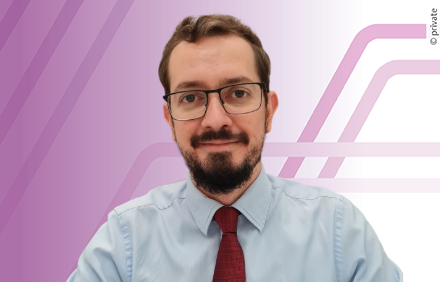
Six Questions to Prof. Carlos Emilio de Lucca
1. Which field of organic chemistry are you interested in the most and why?
I am most interested in the total synthesis of (un)natural products. The endless possibilities of carbonic architecture and functional group ornament make the synthesis of natural and unnatural products an equally unlimited challenge!
2. If there is one thing you would like people to understand about your research, what would that be
Synthesizing a new molecule is like playing Lego, but with much smaller pieces. Sometimes you can use the manual, sometimes you need to find new ways to put the pieces together!
3. What do you do to relax after a busy day?
I am a big consumer of TV series, sometimes accompanied by a beer or wine. I also enjoy reading, currently I’m reading Dostoyevsky’s Crime and Punishment. Sometimes I take a walk, but less than I should…
4. Given the chance to meet any chemist (living or dead) who would it be and why?
Hermann Emil Fischer. In my classes, I try to bring some of the history behind the transformations or the discoveries, and talking about Fischer’s synthesis and determination of sugars with the tools available at the time makes me really excited!
5. Which potential do you see in organic chemistry in the future?
Every day, more selective and efficient methods and transformations appear. I see organic chemistry playing an increasingly central role in people’s daily lives, bringing cheaper and more efficient medicines, delivering more food or even in the development of new materials for anything we are able to think of.
6. Which difficulties are there for young upcoming chemists in your field? Do you have any tips
I would not restrict my answer to a young chemist, but to a young person in general. A great difficulty we have faced is misinformation and lack of interest in reliable information. We need to invest some of our time outside of universities and laboratories and speak to our community in a clear language about the benefits of science.
Watch the Cheminar Recording “Rising Stars in Organic Synthesis, Session 3”
In this online seminar Emilio de Lucca presents his work on “The Use of C–H Bond Oxidations in the Synthesis of Natural Products”.
Selective oxidations play an important role in chemical access to more diverse products in a regio-, chemo- and diastereoselective manner. More specifically, the oxidation of C–H bonds has emerged as a powerful tool in the insertion of oxygenated functionalities at a late stage in the synthesis of complex molecules, eliminating the need for additional manipulations of functional groups. In this sense, we will show our recent efforts in the synthesis of natural diterpenes through selective oxidation reactions.