

SOS Platform, SOS eBooks or SOS Datasets
The content of Science of Synthesis is available in three different “aggregate states”. Depending on your needs, you can explore its wealth of knowledge either via the SOS Online Platform or within the SOS eBooks. Alternatively, you can use the SOS Reaction Datasets, where all the structures and reactions are in machine-readable format that can be used for cheminformatics applications, such as training algorithms.

SOS Platform: The Perfect Synthesis Solution for Your Institution
With the SOS Platform you can save time and effort by reducing, or even avoiding, extensive literature research. On the SOS Platform, you can quickly find the answers you are looking for. You can benefit from the comprehensive search functionality and the chemist-friendly user interface. You can be sure that, as the content is regularly updated, newly established methods and techniques are also covered.
As well as text searching, using the built-in drawing tool, the structure/reaction search mode helps you to find potential routes to your target molecule or find out how a molecule might react further. Alternatively, you can browse through the whole platform to discover alternative options, and related reactions – perhaps giving you inspiration to try something you never would have thought of?
The SOS Platform is the perfect solution for your company, institution, or research group.
SOS eBooks: Keep Your Library Up-to-Date with SOS eBook Packages
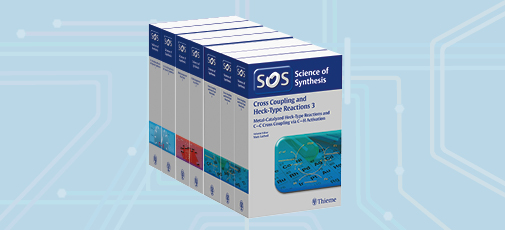
The SOS eBook Collection comprises more than 300 volumes, covering over a century of synthetic organic chemistry. Starting from the original German “Houben-Weyl” print editions, the complete content was rewritten and revised in the English language Science of Synthesis series.
Since 2010, the “Knowledge Updates” are regularly added to supplement Science of Synthesis with new and improved methods and new product sub(classes). The “Reference Library” volumes cover the latest trends in organic chemistry and related disciplines, from electrochemistry in organic synthesis to DNA-encoded libraries.
You can purchase the SOS eBook volumes by publication year in order to keep the collection in your own library up to date. Alternatively, if you focus on a special research field, you can buy bundled topic-related packages (for example the organometallic series).
SOS Datasets: Science of Synthesis Knowledge in Machine-Readable Format
The SOS Datasets are high-quality, machine-readable structure and reaction datasets derived from the expert-curated Science of Synthesis reference work on organic and organometallic chemistry. The data contains reliable, synthesis-relevant reactions that have been selected by proven experts. The SOS Datasets can be used for the training of AI models and algorithms designed for reaction prediction and retrosynthesis.
The SOS Datasets are intended for “real-life chemists” such as process, medicinal, or synthetic organic chemists, as well as “virtual chemists” including cheminformaticians, theoretical chemists, and data scientists involved in computer-aided synthesis design and reactivity modeling.
SOS Datasets are designed to support chemical institutes and companies for training their inhouse models or supplementing existing datasets, as well as for software companies providing synthesis solutions to their customers.
Latest News from the SOS Editorial Office
Case Study: Unsymmetrical Polysulfidation
Our research group has long been committed to sulfur chemistry. In particular, polysulfide synthesis attracts our attention due to the potential medicinal and material properties of polysulfides. Thus, we designed and synthesized bilateral disulfurating reagents to investigate better methodologies for polysulfide synthesis (Scheme 1).

New SOS: Exclusive Sneak Preview
Science of Synthesis is moving on to a new chapter and we are excited to share a preview of what’s coming. Discover how the new, more intuitive platform will make daily work smoother, faster, and more efficient for anyone involved in organic synthesis.

Recommended by Leading Chemists
Science of Synthesis Is Recommended by Leading Chemists: Top chemists worldwide highlight SOS for its exceptionally well-organized insights into organic chemistry, which are tailored for graduate students, as well as scientists and researchers in academia and industry.

Release 4.32
We are thrilled to announce that Professor David Sarlah from Rice University, USA, becomes a member of the Science of Synthesis Editorial Board with effect of October 1st, 2025. David obtained his bachelor’s degree in chemistry from the University of Ljubljana in his home country Slovenia before moving to the…

David Sarlah
We are thrilled to announce that Professor David Sarlah from Rice University, USA, becomes a member of the Science of Synthesis Editorial Board with effect of October 1st, 2025. David obtained his bachelor’s degree in chemistry from the University of Ljubljana in his home country Slovenia before moving to…

Tehshik Yoon
We are excited to report that Professor Tehshik P. Yoon from the University of Wisconsin-Madison, USA, joins the Science of Synthesis Editorial Board as a new member with effect of October 1st, 2025. Tehshik was born in Montréal (Canada) and grew up in Blacksburg, VA (USA). He earned his AB…

SOS Knowledge Updates: Volume Editor Renzo Luisi
Renzo Luisi, of the University of Bari (Italy), has joined the team of editors for the SOS Knowledge Updates series. He will be responsible for content relating to Volume 8 on Compounds of Group 1 (Li...Cs).